Drying removes moisture from a wet product - following filtration, wet granulation, or a water-based synthesis step - down to a target moisture content suited to the product's stability and end use. Several drying technologies exist, each suited to different product forms and sensitivities. This page introduces the main methods.
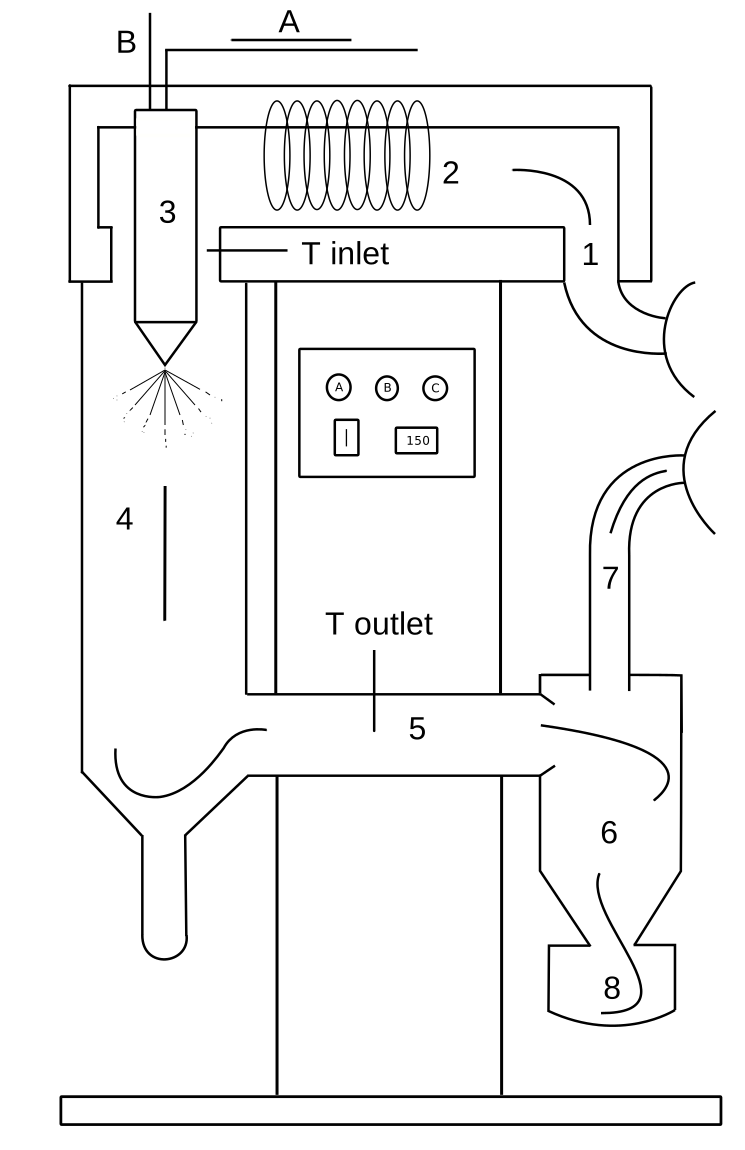
Key points
- Spray drying converts liquids directly into powder, offering efficient drying due to the large surface area of atomised droplets.
- Drum drying suits products that can be applied as a film to a heated rotating cylinder.
- Vacuum drying lowers the boiling point of solvents, allowing drying at lower temperatures for heat-sensitive products.
- Final moisture content is the primary quality measure and should be specified clearly.
Spray Drying
Spray drying atomises a liquid, emulsion, suspension or paste into fine droplets, creating a large surface area for rapid heat and mass transfer, and is widely used to generate powdery or granular solid products directly from a liquid feed. It's one of the most common drying methods across chemical and related industries due to its efficiency and ability to handle a wide range of feed materials.
Drum Drying
Drum drying uses a rotating heated cylinder, with the liquid-phase material applied to the outer wall and dried by conduction as the drum rotates, then scraped off as a dried film. This method is used for certain chemical products, including some polymer and vitamin-containing materials, where a continuous drying operation is preferred.
Vacuum Drying
Vacuum drying reduces pressure around the material being dried, which lowers the boiling point of the solvent involved and allows drying to take place at a lower temperature - a significant advantage for heat-sensitive products that would degrade under standard atmospheric drying temperatures.
Suitable Materials and Products
Drying commonly follows filtration or wet granulation - see filtration and granulation - or converts a liquid formulation directly into a powder form. Method choice depends on the product's heat sensitivity, target final form, and production volume.
Equipment and Technical Considerations
Other drying equipment includes rotary drum dryers, fluid bed dryers, conveyor and tunnel dryers, and freeze dryers for particularly heat-sensitive materials. Equipment choice should be matched to the specific product characteristics rather than assumed from a single default method.
Batch Sizes and Production Scale
Drying capacity depends on the specific equipment and method used, and can be either batch or continuous depending on the technology - continuous methods like spray drying often suit higher-volume production, while batch methods like tray or vacuum drying may suit smaller or more specialised runs.
Quality and Regulatory Considerations
Final moisture content is the key quality measure for a dried product, typically tested against a specified maximum to ensure product stability during storage - see setting quality specifications.
Choosing a Drying Method
Drying method is largely determined by how heat-sensitive the material is and what physical form is wanted. Spray drying produces fine powder directly from a liquid feed with very short heat exposure, which suits sensitive materials. Vacuum drying lowers the boiling point so material dries at lower temperature, essential where degradation is a risk. Tray, drum and fluid bed methods each suit different combinations of throughput, form and sensitivity.
The choice affects the product, not just the process. Spray-dried powder has different particle characteristics from material dried in a tray and then milled, and those differences can affect dissolution, bulk density and handling - so drying method belongs in the process specification.
What to Watch
Residual moisture is the parameter that matters most and it needs specifying with a method, since different techniques give different answers. Too much residual moisture affects stability, caking and shelf life; over-drying wastes energy and can damage the product.
Drying is energy-intensive and often the slowest step, so it frequently determines cycle time and cost. It also generates dust in the later stages, bringing the usual containment and explosion considerations - see ATEX and flammable atmospheres. Where solvent is being removed rather than water, recovery and emissions become relevant too.
Questions to Ask a Manufacturer
- Which drying method do you recommend for our product, and why?
- What final moisture content can you reliably achieve?
- Is your drying process batch or continuous, and how does that affect our target volumes?
- How do you handle heat-sensitive materials during drying?
Related Manufacturing Capabilities
Frequently Asked Questions
Which drying method is fastest?
Spray drying is generally very efficient due to its large surface area for heat and mass transfer, but the right choice depends on the target product form and heat sensitivity, not speed alone.
Does drying always produce a powder?
Not necessarily - drum drying and some other methods produce a film or flake form rather than a fine powder, depending on the equipment and material.
Can vacuum drying be used for any heat-sensitive product?
It's a common solution for heat-sensitive materials, but suitability should be confirmed with the manufacturer based on your specific product and solvent system.
Find a Manufacturer
Find a UK Contract Chemical Manufacturer
Search the directory of UK contract and toll manufacturers by process, industry and capability.
Search the DirectoryLast reviewed: August 2026. Regulation and guidance change — verify anything you rely on against the primary source. Tell us if something here is out of date.